Kazakhstan’s central bank launched a pilot project with a new stablecoin pegged to the local fiat currency in collaboration with Solana and Mastercard.
The National Bank of Kazakhstan announced the launch of the stablecoin project within the framework of its Digital Assets Regulatory Sandbox, according to a statement shared with Cointelegraph on Tuesday.
The new Evo (KZTE) stablecoin is pegged to the Kazakhstani tenge currency and is issued by sandbox participant Intebix crypto exchange and local lender Eurasian Bank, with assistance from Solana and Mastercard.
Based on the Solana blockchain, KZTE is immediately live within the central bank’s regulatory sandbox, and Mastercard is set to connect KZTE with global stablecoin issuers, Intebix founder Talgat Dossanov told Cointelegraph.
National stablecoin to bridge crypto and TradFi
Kazakhstan’s Evo stablecoin is described as a “national stablecoin” designed to connect crypto innovation with traditional finance.
Use cases for the KZTE stablecoin include expanding the crypto-fiat channel, enabling cryptocurrency exchange and supporting transactions through crypto cards.
“The project is part of the National Bank’s strategy to build a national digital asset ecosystem, fostering innovative digital tools and the development of Kazakhstan’s digital asset market,” the announcement noted.
Promotional image of the new tenge-backed stablecoin. Source: Intebix
While the Evo stablecoin is technically issued by Intebix and the Eurasian Bank, the National Bank of Kazakhstan is participating in the project by providing a regulatory regime to allow its issuance and testing.
“It’s still the first case where the central bank is taking a proactive role in the issuance of the stablecoin,” Dossanov told Cointelegraph.
Kazakhstan’s first stablecoin
“Today, we are launching Kazakhstan’s first stablecoin denominated in our national currency, the tenge, within the National Bank’s regulatory sandbox,” National Bank Governor Timur Suleimenov reportedly said during the Evo opening event on Tuesday.
Suleimenov emphasized that the digital age presents both challenges and opportunities, with digital assets and blockchain technology playing a central role in delivering new services, enhancing financial inclusion and driving the country’s overall advancement.
Intebix founder Talgat Dossanov, Eurasian bank CEO Lyazzat Satiyeva, National Bank Governor Timur Suleimenov, Mastercard CIS executive Rafal Trepka (from left to right). Source: Solana Superteam
Kazakhstan’s Evo stablecoin launch comes in line with the country’s ambitious digital asset agenda, including exploring the concept of a state-run crypto reserve.
Related: Kazakhstan’s president calls for national crypto reserve, digital asset law by 2026
In early September, Kazakhstan’s Astana Financial Services Authority officially authorized the use of USD-pegged stablecoins including Tether USDt (USDT) for payment of license and supervision fees.
Kazakhstan has also emerged as a global leader in Bitcoin (BTC) mining, becoming one of the biggest BTC mining countries by the mining hashrate distribution in 2022, with a share of 13%.
Kazakhstan has also been making moves with a central bank digital currency (CBDC), launching the digital tenge in November 2023. The initiative has brought significant improvements to VAT reimbursement processing, the National Bank’s chief digital officer said last year.
Despite aggressive short-side pressure, the risk of another liquidation event is decreasing.
Bitcoin (BTC) fell from its monthly high of about $118,000, dropping as much as 5.5% to Tuesday’s intraday low of $111,571. While this is only a 10.4% drawdown from the $124,500 all-time high, several metrics suggest that the price range between $112,000 and $111,500 may be the bottom range before BTC recovers to new highs.
Coinbase Premium stays positive despite price dip
Bitcoin’s recent recovery to a four-week high of $118,000 from a low of $107,400 between Sept. 1 and Thursday may be partially attributed to increased retail demand in the United States. That was evident by a sharp rise in the Coinbase Premium Index over that period.
The Coinbase Premium Index measures the difference in pricing between the BTC/USD pair on the largest US exchange, Coinbase, and Binance’s BTC/USDT equivalent.
Related: Biggest long liquidation of the year: 5 things to know in Bitcoin this week
The index remained positive, rising to 0.075 on Monday from 0.043 on Sunday, even as Bitcoin tumbled 4% to $112,000.
“The Coinbase premium stayed positive all week,” even with the latest sell-off, said analyst BTC_Chopsticks in an X post on Monday, adding:
“As long as the index stays positive, I remain bullish on BTC.”
A rising Coinbase premium is a proxy for increasing demand from US retail investors.
Additionally, Bitcoin’s apparent demand, which offers a broader onchain view of worldwide BTC demand, remains high despite yesterday’s price drop, with a slight increase over the last 24 hours.
Bitcoin apparent demand. Source: CryptoQuant
This suggests that new investors continue entering the market, providing the tailwinds required to trigger BTC price recovery.
Institutional Bitcoin demand “remains firm”
BTC’s upside potential is backed by growing institutional demand, evidenced by strong inflows into Bitcoin investment products.
Data from CoinShares shows that institutional investors increased their exposure to Bitcoin investment products, which saw inflows of $977 million, making up more than 51% of the total inflows last week.
Crypto ETP flows table. Source: CoinShares
US-based spot Bitcoin ETFs saw $876 million in net inflows last week, data from SoSoValue shows.
Bitcoin treasury companies are aggressively accumulating, with Japan’s Metaplanet becoming the fifth-largest Bitcoin holder after acquiring 5,419 BTC for $632.53 million, bringing its total to 25,555 BTC worth nearly $3 billion.
Michael Saylor’s Strategy added 850 BTC for $99.7 million last week, bringing its total Bitcoin holdings to 639,835 BTC.
“Despite near-term weakness, institutional support remains firm,” trading company QCP Capital wrote in a note to investors on Tuesday, adding:
“Strategy and Metaplanet continue to add, while spot ETF inflows last week signal sustained dip-buying. ”
Traders are also positioning for October, which is “historically BTC’s strongest month, with active demand for 120K–125K Calls,” it added.
BTC absorbs sell-side pressure from short traders
Despite sustained sell-side aggression on Binance derivatives since mid-July, Bitcoin has mostly held its ground within a tight $110,000–$120,000 range. Cumulative Volume Delta (CVD) data remains negative, signaling consistent short-selling pressure from takers.
The inability of the price to break significantly lower suggests that this flow is being absorbed, implying accumulation.
Cumulative Volume Delta on Binance. Source: CryptoQuant
This structural resilience may be reinforced by liquidation data pointing toward reduced downward pressure.
Bitcoin researcher Axel Adler Jr said that although the massive long liquidations seen Monday suggested that bears are dominating the market, the frequency of liquidations remains low, adding:
“Risk of further bearish pressure from liquidations is medium.”
Risk of further bearish pressure from liquidations is medium.
Net Liquidations remain negative near −40M, reflecting ongoing long wipeouts and keeping downside pressure in place. Yet the Liquidation Intensity Z-Score (365d) is neutral/moderate, suggesting no cascade risk for… pic.twitter.com/FRu9spsyCZ
High US retail demand, strong institutional support and reduced risk of a liquidation-driven drop strengthen the argument that Bitcoin is forming a bottom near $112,000.
While short-term volatility may persist, the underlying bid, possibly institutional, could make a sharp correction below this level increasingly unlikely.
This article does not contain investment advice or recommendations. Every investment and trading move involves risk, and readers should conduct their own research when making a decision.
Solana has always pitched itself as the blockchain for speed. With Alpenglow, it’s attempting a quantum leap.
Validators have voted overwhelmingly in favor of the upgrade, with almost 99% support across the network. If successfully implemented, Alpenglow is expected to reduce transaction finality from roughly 12.8 seconds to just 100 to 150 milliseconds.
That’s close to a hundred times faster than current speeds and well within the range of internet benchmarks most people take for granted.
To put that into perspective, a Google search averages about 200 ms. Payment processors like Visa settle card transactions in a similar timeframe. If Solana can truly operate in that window, blockchain applications might feel indistinguishable from traditional systems.
The shift could redefine user expectations of crypto entirely.
How Solana stacks up against rivals
Even before Alpenglow, Solana carved out a reputation as one of the fastest major blockchains.
Its 12.8-second finality already outpaces Ethereum’s confirmation cycle, which typically takes 12 seconds for inclusion and around 12 minutes to reach true finality through its checkpointing mechanism.
By comparison, Sui, a layer-1 built for performance, boasts around 400-ms finality, which is impressive but still more than double what Alpenglow targets.
If Solana delivers on its promises, the gap could reshape the competitive landscape. For decentralized exchanges, derivatives platforms and blockchain-based games, sub-second finality becomes a prerequisite for real-time interaction.
Users who have grown accustomed to the lag of most Web3 systems could experience something far closer to the immediacy of Web2.
Did you know? In 2024, CoinGecko Research revealed that Solana garnered a whopping 38% of global crypto investor interest in chain-specific narratives, surpassing Ethereum’s 10%.
Inside the governance vote
The governance process for Alpenglow kicked off on Aug. 21, 2025, spanning epochs 840 through 842.
Participation was strong right from the outset. Validators and stakers quickly cleared the 33% quorum requirement, ensuring the proposal couldn’t stall out.
As ballots rolled in, support proved overwhelming. Early tallies showed backing between 99.6% and 99.7%, with only a sliver of participants voting against.
By the time the vote closed on Sept. 4, 2025, 98.94% of all participating stakeholders had approved the measure. Roughly 0.5% opposed, and another almost half-percent abstained.
Crucially, participation hit around 52% of the network’s total stake, comfortably above the minimum threshold and strong enough to suggest broad legitimacy.
Such near-unanimity is unusual in decentralized governance, where divisions often emerge even on technical upgrades. For Solana, the outcome shows alignment among stakeholders regarding Alpenglow’s necessity.
The mechanics of Alpenglow
At Alpenglow’s core are two new architectural components: Votor and Rotor.
These systems overhaul how Solana processes and finalizes transactions, allowing the chain to confirm blocks in 100-150 ms. Instead of waiting for multiple rounds of validator communication, the upgrade enables faster consensus without compromising security guarantees.
Alongside speed, Alpenglow introduces a new economic model. Validator Admission Tickets (VATs) aim to streamline validator onboarding while reducing operational costs.
Paired with the “20 20” resilience model, where the network can tolerate up to 20% of validators failing and another 20% behaving maliciously, Solana gains robustness against disruptions.
Now, building decentralized finance (DeFi) platforms, trading engines or multiplayer games will be possible without the awkward delays users often endure. Transactions could feel instant, which will likely unlock use cases that previously required centralized infrastructure.
Risks native to Solana
Alpenglow’s promise is extraordinary, but the upgrade doesn’t erase every concern hanging over Solana.
The network still depends almost entirely on Agave, its main validator client. A bug or exploit in that client could ripple across the entire ecosystem.
However, relief is coming in the form of Firedancer, a second validator client built by Jump Crypto.
Expected to debut on the mainnet later this year, Firedancer could diversify the network’s software base and drastically improve resilience.
Having multiple independent clients is standard in other ecosystems (Ethereum runs on Geth, Nethermind, Besu and Erigon), so Solana’s reliance on just one remains a red flag until Firedancer is fully operational.
There are also questions about centralization.
While VATs and cost reductions aim to lower entry barriers, some critics argue that fixed-tier fees and fault-tolerance thresholds could favor larger validators with deeper resources.
If that dynamic plays out, the network risks trading one bottleneck (speed) for another (concentration of power).
Did you know? Researchers recently uncovered specialized phishing techniques targeting Solana (coined “SolPhish”) that have led to $1.1 million in losses. Ahead of this, they developed SolPhishHunter, a pioneering detection tool for the ecosystem.
Why it matters beyond speed
The headline number (150 ms) grabs attention, but the real story is what that speed enables.
Consider a decentralized exchange (DEX). Today, even the best DeFi platforms can’t match the responsiveness of centralized order books. It is not unusual to see market conditions shifting considerably by the time a transaction clears.
With Alpenglow, order books could update in real time, giving traders the same fluid experience they expect from centralized platforms — without sacrificing custody.
The benefits are even more obvious with gaming. Blockchain-based games often stumble when interactions lag or require long confirmation windows. Sub-second finality could make in-game economies feel flawless, whether that’s trading items, earning rewards or settling bets.
Moreover, for payments, Alpenglow could be a breakthrough. Sending stablecoins across borders in 150 ms would put crypto payments on par with credit card networks.
Combined with Solana’s low fees, the upgrade positions the network as a genuine alternative for real-time settlement.
Infrastructure for enterprise-grade finance
Sub-second finality paired with stronger resilience mechanisms creates a blockchain that appeals greatly to businesses that can’t afford downtime.
The same goes for the 20 20 resilience model, reassuring players who worry about network stability.
The numbers already point to growing institutional trust. Three publicly listed companies have collectively staked around $1.7 billion on Solana, which demonstrates confidence in its long-term stability.
Beyond staking, the ecosystem is broadening. Tokenized real-world assets (RWAs) on Solana now total roughly $390 million, while total value locked (TVL) has climbed past $8.6 billion.
Staking yields averaging about 7% are also fueling demand for new investment products, with exchange-traded funds (ETFs) tied to Solana (SOL) recording millions in inflows.
Solana is moving well beyond retail adoption and speculation, positioning itself as infrastructure capable of supporting enterprise-level finance.
Did you know? Major financial entities, including HSBC, Bank of America, Euroclear and the Monetary Authority of Singapore, are integrating Solana into their tokenization efforts via a strategic partnership with R3.
What’s next for Solana?
With governance finalized, Solana’s roadmap is firmly in motion.
A testnet deployment of Alpenglow is scheduled for December 2025 at the Breakpoint conference, followed by a mainnet upgrade in Q1 2026. In parallel, Firedancer is progressing through a phased rollout.
Already operating in a hybrid “Frankendancer” mode on more than 10% of validators as of mid-2025 (and demonstrating throughput above 1 million transactions per second in testing), it represents a decisive step toward client diversity.
For Solana, the stakes are high as it aims for sub-100 ms finality while also ensuring resilience against single-client risk.
If successful, the combination of Alpenglow and Firedancer will both lock in Solana’s performance edge for high-throughput applications. Together, these updates will provide a more inclusive foundation for smaller validators and developers, strengthening the ecosystem’s long-term credibility.
Tech behemoth Samsung has partnered with decentralized science (DeSci) and healthcare artificial intelligence protocol Galeon to provide AI training data from its ultrasound devices.
According to a Tuesday announcement shared with Cointelegraph, Samsung said it will integrate its ultrasound equipment with Galeon’s electronic health record (EHR) platform. Speaking to Cointelegraph, Galeon CEO Loïc Brotons said the EHR is already live in 18 interconnected hospitals, including those in France at Rouen University Hospital, Caen University Hospital, Toulon Hospital and Sud Francilien Hospital.
Samsung and Galeon said the effort aims to improve medical data availability while keeping a privacy-first approach. Brotons said the data itself is not stored onchain; only the AI algorithm operates onchain “with full traceability of how the algorithm is operating.” He added that all data is anonymized before training for privacy compliance reasons.
The collaboration allows healthcare providers to train AI models without centralizing patient information. Each hospital or institution retains control over its data while benefiting from shared algorithm training.
Brotons told Cointelegraph that this approach to medical AI training is already making an impact. He claimed that the firm has developed an automatic billing AI for medical services, an AI that provides a summary of consultations and is working on its own speech-to-text AI.
The Galeon Team. Source: Galeon
Related: Blockchain and AI can enable advanced personalization in healthcare
Decentralized science takes on medicine
Healthcare has emerged as one of the most active sectors in decentralized science. Alex Dobrin, awareness steward at VitaDAO — a decentralized collective working to extend human lifespans — told Cointelegraph that the time and cost requirements of drug development motivate people to take matters into their own hands.
In May, DeSci decentralized autonomous organization HydraDAO claimed that one of its research projects resulted in “rats who had their spines fully transected” being able to walk again in five days. Such news appears to be prompting investors to take notice.
Related: Decentralized science meets AI — legacy institutions aren’t ready
Investors show interest in DeSci
DeSci platform Bio Protocol secured backing from investors, including Maelstrom Fund and Animoca Brands, in a $6.9 million funding round earlier this month. This followed the company’s investment from Binance Labs, the cryptocurrency exchange’s venture capital arm, at the end of 2024.
Data is at the center of many of those projects, with DeSci platforms now fighting to acquire genetic data from bankrupt DNA testing service 23andMe.
Bitcoin will be “markedly higher” by 2028, Arthur Hayes said, but $3.4 million per coin is too bullish.
BTC price increases from credit growth may not match past performance.
US money printing is back with the Trump administration, opening the path to BTC price expansion.
Bitcoin (BTC) will trade “markedly higher” than its current $113,000 by 2028, said former BitMEX CEO Arthur Hayes.
In his latest blog post, “Four, Seven,” released Tuesday, Hayes sees money printing taking BTC price action to new records.
Hayes sees BTC price “markedly higher”
US money printing under the President Donald Trump administration will be what launches Bitcoin into the stratosphere in just three years, Hayes said.
Trump aims to “preserve the fruits of the supposed empire for the ruling class,” something attempted by US presidents before him.
“Today, another war against a more united, prosperous, and militarily strong Eurasia (Russia, China, India, and Iran) requires a drastic change in credit allocation,” Hayes said.
“And therefore, I proclaim with extreme confidence regarding money printing, these crackers ain’t playin’.”
To do this, Trump needs to gain sway over the Federal Reserve, with his placements steering monetary policy toward money printing via a potential deal with the US Treasury. The ongoing debacle involving Fed governor Lisa Cook, appointed by the previous administration, is just the start.
“The point is, do not doubt that team Trump will use all the tricks in the book to print the money this transformation of America requires,” the post continued.
Federal Reserve Board of Governors data (screenshot). Source: Arthur Hayes/Substack
Hayes goes on to consider how Bitcoin might react. While estimating actual prices is next to impossible, previous experience hints at a seismic shift in the BTC price.
“The slope of the percentage increase in Bitcoin to a dollar of credit growth was ~0.19. Ladies and gentlemen, that results in a 2028 Bitcoin price prediction of $3.4 million!” he calculated.
“Do I think Bitcoin will rise to $3.4 million by 2028? No, but I believe the number will be markedly higher than the ~$115,000 that it trades at today.”
How high is too high for Bitcoin?
Hayes is no stranger to BTC price targets, with seven-digit forecasts becoming a regular feature of his musings on the world’s economic future.
Related: Bitcoin price $150K target comes as analyst sees weeks to all-time highs
Pardoned by Trump in March, Hayes previously eyed a $1 million price tag by 2028 due to international capital controls and “repatriation” of foreign wealth.
Last week, along with repeating the $1 million figure on X, Hayes tipped Treasury liquidity conditions as a reason to expect a mass surge across crypto markets next.
Not everyone agreed. Andre Dragosch, European head of research at crypto asset manager Bitwise, called the liquidity argument a “useless banana.”
As Cointelegraph continues to report, market expectations for easier financial conditions remain high, with the Fed tipped to cut interest rates again at its October meeting.
This article does not contain investment advice or recommendations. Every investment and trading move involves risk, and readers should conduct their own research when making a decision.
Grok 4 can analyze real-time X chatter, market data and onchain flows to highlight potential altcoin moves.
Social surges, exchange listing rumors, whale transactions and leverage spikes are among the earliest indicators of a pump signal.
Traders can use Grok 4 prompts to filter noise, rank coins by hype intensity and cross-check signals for higher conviction.
While Grok 4 can help anticipate opportunities, pump-and-dump groups and low-liquidity traps remain major risks.
Altcoin pumps don’t just appear out of thin air. They are usually preceded by whispers on X, sudden trading volume on decentralized exchanges (DEXs) or a suspicious whale transfer. The challenge has always been processing this firehose of data on time.
This is where Grok 4, xAI’s newest model, comes in. It has real-time access to public X posts and can run live web searches. Instead of scrolling endlessly through hashtags and crypto groups, a trader can ask Grok 4: “Which tokens have had the biggest spike in mentions in the past hour, and what’s driving it?”
That combination of social and data awareness makes Grok 4 especially useful for those trying to catch pumps early before the mainstream notices.
Traditional trading tools are mostly backward-looking. By the time volume spikes show up on TradingView or an exchange lists a new pair, the “early” part of the pump is already gone. Traders are left reacting instead of anticipating.
What makes Grok 4 different is its ability to scan X in real time while also pulling in onchain flows, funding rates and whale activity through connected APIs or trusted sources. In other words, it doesn’t just tell you what has already happened; it highlights the conversations, rumors and wallet behaviors that usually come before the charts explode.
For example:
If a memecoin suddenly doubles in mentions on X within one hour, Grok 4 can flag it instantly.
If a known whale wallet sends millions to Binance, Grok can pull that alongside relevant community chatter.
If funding rates on a small-cap perpetual pair heat up, Grok can show whether it’s organic enthusiasm or manufactured hype.
This “cross-signal awareness” is something traders often try to piece together manually by juggling multiple dashboards, crypto groups and alerts. Grok 4 condenses it into a single conversational interface where you can literally ask, “Which coins look like they’re setting up for a pump right now, and why?”
That’s why Grok 4 is increasingly seen as a tool for spotting altcoin moves at the narrative stage, not just the market stage. Once you understand the kinds of signals that typically precede a rally, you can use Grok to filter noise, rank opportunities and prepare before the wider market piles in.
Did you know? Community chatter often leads to market action. A large-scale research study of subreddit activity found that spikes in discussion volume frequently preceded price increases, and a simple strategy based on this pattern could have delivered higher returns.
The main signals behind altcoin pumps
1. Social media surges
Tokens like Pepe (PEPE) and Floki (FLOKI) didn’t rally first on charts; they rallied first on X timelines. A flood of memes and influencer posts can mark the start of an altcoin wave.
Grok 4 use case: Ask Grok to scan for tokens with a sudden jump in mentions or hashtags, then summarize the top three reasons people are talking about them.
Example prompt:
“List the top two altcoins with the fastest growth in X mentions over the past two hours. For each, explain in a sentence why they are trending and whether the posts look organic or shill-driven.”
2. Exchange listing rumors
Centralized exchange (CEX) listings are one of the most consistent pump catalysts. Tokens often build heat on DEXs first, then surge on the rumor (or confirmation) of a Binance or Coinbase listing.
Grok 4 use case: Monitor X posts, project announcements and community groups for hints of exchange activity.
Example prompt:
“Are there any credible posts on X in the last 24 hours suggesting upcoming exchange listings for altcoins under $200M market cap? Summarize the most likely candidates.”
3. Funding rates and leverage
When funding rates on perpetual swaps spike, it shows traders are aggressively betting in one direction. That often fuels explosive moves but also signals a possible squeeze.
Grok 4 use case: Instead of digging into raw numbers, Grok can explain which tokens have “overheated” leverage and what that might mean.
Example prompt:
“Which altcoin perpetual pairs currently have funding rates much higher than their 30-day average? Explain whether this suggests bullish overcrowding or potential liquidation risk.”
4. Whale transactions
Big wallets often move before the crowd. A sudden $10-million transfer onto an exchange, or accumulation by a known whale, can be a tell.
Grok 4 use case: Connect Whale Alert feeds to Grok, then ask it to contextualize moves against market chatter.
Example prompt:
“Summarize the three largest whale transactions in the past 12 hours and check if there was any major news or social discussions around the same tokens.”
5. Coordinated pump groups
Social media often sees “pump-and-dumps.” Identifying them early is useful for knowing what to avoid.
Grok 4 use case: Ask Grok to highlight suspiciously synchronized posts or pump-like countdowns.
Example prompt:
“Scan X chatter for mentions of coordinated pump events scheduled in the next 24 hours. Flag the tokens mentioned and estimate credibility.”
6. Putting it all together
Instead of chasing every signal, traders can combine multiple Grok 4 outputs into a composite view to prepare their own “Early Pump Score”:
If two or three of these align, Grok can help produce a short “Why now?” summary that explains why a token is heating up.
Example prompt:
“For tokens with high social activity, cross-check with funding rate spikes and whale moves. Rank them by overall pump potential and explain in plain English why each might move.”
How to get started with Grok 4
Unlike traditional data tools, Grok 4 doesn’t require coding to be useful. A basic setup looks like this:
Access Grok 4: Through an X Premium+ subscription (for direct chat) or via API if you are advanced.
Pick your focus: Social mentions, exchange rumors or whale activity. Don’t try to track everything at once.
Write clear prompts: The sharper the prompt, the better the output. Use time frames (“last two hours”) and filters (market cap, token type).
Cross-check results: Don’t rely on one signal. Use Grok to connect dots between hype, onchain flows and leverage.
Start small: Treat Grok insights as an early warning system, not a guarantee.
Risks and limitations
Even with Grok 4, traders should proceed carefully:
Not all hype is genuine: Many altcoin pumps are engineered as coordinated exits by insiders or pump groups, leaving late entrants holding the bag.
Liquidity traps can be costly: Small-cap tokens may show triple-digit percentage gains on charts, but low liquidity can make it nearly impossible to exit a position at size.
Exchange-driven rallies are short-lived: Coins that surge on the back of new listings or rumors often retrace sharply within days once the initial excitement fades.
Backtesting is non-negotiable: Traders should always test whether Grok 4’s identified signals have historically predicted meaningful moves before committing real capital.
Altcoin pumps are chaotic, fast-moving and risky, but they’re rarely random. With Grok 4’s real-time access to social chatter and data, traders can filter noise, spot narratives before they go mainstream and prepare for volatility.
Used wisely, Grok 4 isn’t about blindly chasing every pump; it’s about turning information overload into clear, actionable signals, helping traders stay a step ahead without becoming exit liquidity.
This article does not contain investment advice or recommendations. Every investment and trading move involves risk, and readers should conduct their own research when making a decision.
XRP named Thailand’s top asset for nine straight months
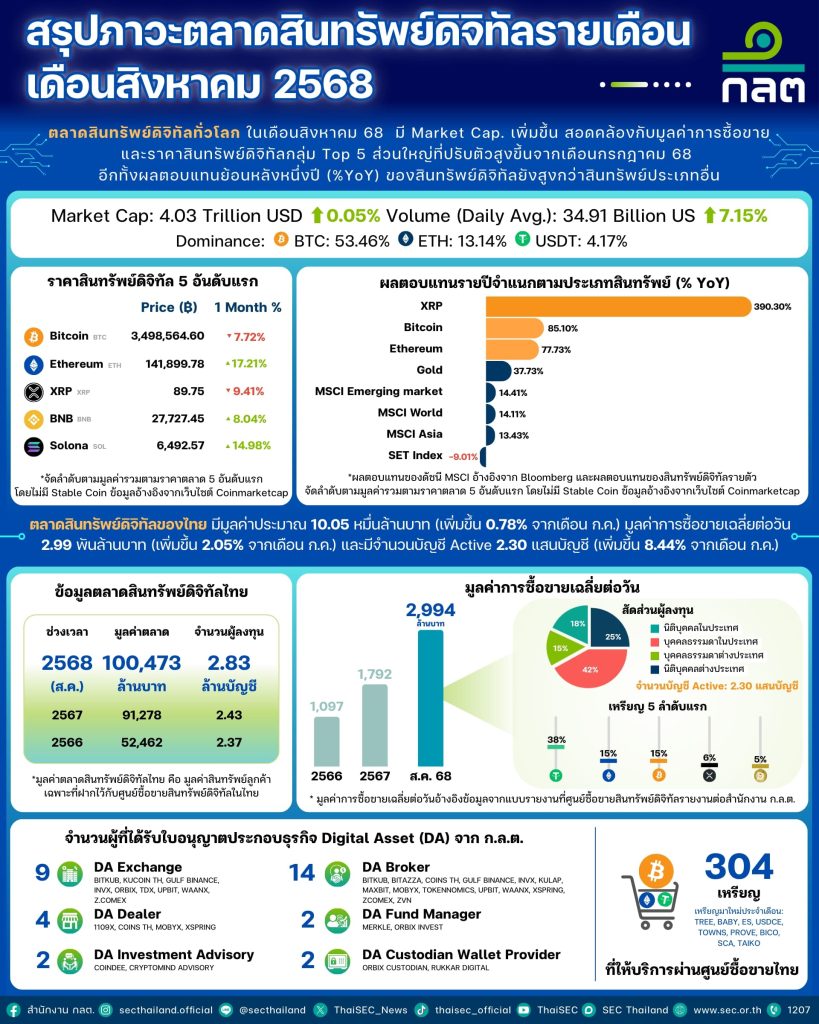
XRP delivered the strongest returns among all major asset classes in Thailand, soaring 390% year-on-year in August, according to the Thai Securities and Exchange Commission’s latest digital asset market report.
Ethereum entered the top three by pushing out gold in August. (Securities and Exchange Commission)
The XRP token has now topped the SEC’s performance rankings for nine consecutive months, outpacing gold, equities and other benchmarks listed in the regulator’s database. Solana was the last asset other than XRP to top Thailand’s chart. Bitcoin and Ethereum rounded out the top three performers in August.
Thailand’s cryptocurrency market continues to expand. Monthly trading volume rose 2.05% to 299.4 billion baht (about US$8.2 billion), while the number of active accounts increased 8.44% to 230,000. Retail investors made up the largest share of trading at 42%, followed by institutional investors (21%), juristic persons (18%) and foreign investors (16%).
Despite growing adoption, crypto remains barred as a means of payment in Thailand, with exceptions such as a pilot program for tourist transactions. On social media, some users noted that crypto could provide an alternative for over 3 million locals recently cut off from bank access in a nationwide crackdown on “mule accounts” — once-legitimate bank accounts rented or sold to illicit actors.
Locals will have to ramp up on their crypto wallet literacy if they want alternative methods to hold their assets. The crackdown also includes cryptocurrency exchanges.
AnchorX’s Chinese yuan-pegged stablecoin
A Kazakhstan-based stablecoin issuer has launched a digital token pegged to the offshore Chinese yuan.
AnchorX said in February that it received an in-principle approval from Kazakhstan’s financial authority to issue its offshore yuan-pegged stablecoin AxCNH on Conflux, a public blockchain that has received policy support in China. AxCNH will target settlement and payments for overseas Chinese firms and partners of the Belt and Road Initiative, Beijing’s ambitious global trade strategy.
China’s trade with BRI partner nations reached 22.1 trillion yuan (about $3.1 trillion) in 2024, with over half of its imports coming from BRI partner countries.
An offshore yuan stablecoin in Kazakhstan targets BRI companies and partners. (AnchorX)
The launch of a yuan-pegged stablecoin does not necessarily signal a shift in China’s crypto stance or suggest that Beijing is preparing to greenlight stablecoins, despite recent rumors. The issue has long been contentious among global crypto users, as investors in the world’s second-largest economy remain barred from core activities such as trading and mining.
China’s currency, the renminbi, operates in two distinct markets. The onshore yuan (CNY) circulates within the mainland under strict capital controls and cannot freely flow across borders. Its counterpart, the offshore yuan (CNH), is used internationally for trade and payments.
Following the introduction of Hong Kong’s stablecoin regulations, major Chinese firms reportedly lobbied the central bank for permission to issue yuan-pegged stablecoins in the city, which serves as the largest market for CNH. However, more recent reports indicate that some Chinese companies may be pulling back from Hong Kong’s stablecoin race.
Read also
Features
Play2Earn: How Blockchain Can Power a Paradigm Shift in Building Game Economies
Features
What are native rollups? Full guide to Ethereum’s latest innovation
Shanghai court sells Filecoin in Hong Kong
A Shanghai district court has carried out the city’s first sale of cryptocurrency seized in a criminal enforcement case, under guidance from the Shanghai Higher People’s Court.
Filecoin is a distributed storage network that was popular among Chinese miners. (manseok Kim)
The Baoshan District People’s Court disposed of more than 90,000 Filecoin, following procedures that mirror a framework unveiled by Beijing police in June for handling seized digital assets.
Under the system, courts entrust tokens to a licensed institution, which delegates trading to a qualified agent. Transactions are executed on a Hong Kong–licensed cryptocurrency exchange at no less than the 20-day average price. Proceeds are then transferred to the court’s account, where they can either be confiscated into the state treasury or returned to the victims.
The Shanghai High Court said the move marked their first successful disposal of digital assets, closing a gap where previous cases lacked a legal path for liquidation.
Read also
Features
Insiders’ guide to real-life crypto OGs: Part 1
Features
Unstablecoins: Depegging, bank runs and other risks loom
Crypto industry to escape annual grilling from South Korean lawmakers
Stablecoins are set to dominate cryptocurrency-related discussions in South Korea’s upcoming annual parliamentary audit.
In previous years, crypto audits often featured lawmakers grilling financial regulators and exchange executives over market failures and manipulation. Last year, the Financial Services Commission was accused of favoring the monopolies of major exchanges.
A South Korean lawmaker blames the FSC for creating a “Squid Game”-like environment that squeezed out smaller rivals in the 2024 audit. (National Assembly)
But throughout 2025, the local industry has not seen the high-profile scandals or major cases of market manipulation that typically trigger such confrontations. As a result, major exchange executives are unlikely to be summoned this year. Instead, attention is shifting to stablecoins, a policy priority for President Lee Jae-myung, whose administration took office in June on a crypto-friendly stance.
According to local media citing unnamed sources, legislators are expected to request data from exchanges on inflows and outflows of US dollar-pegged stablecoins.
The National Assembly’s audit is scheduled to begin around Oct. 13, immediately after Chuseok, a holiday often described as Korea’s Thanksgiving. Lawmakers on the National Policy Committee, which oversees financial and crypto-related issues, have already begun drafting witness lists.


 Adler Jr (@AxelAdlerJr)